

The Apron
How a family from Oaxaca stitched itself into the fabric of Portland

Back in 2018, I had just opened my little shop — Kiosko.
It was small. Honest. A little naïve.
Portland felt different then. Smaller. Quieter. There weren’t a lot of us — not openly, not loudly — celebrating what it meant to be Mexican-American in business. There wasn’t a blueprint. There wasn’t a playbook. You either assimilated quietly or risked being misunderstood.
That’s when I met Levi and his brother Martin.
A Mexican family. Living in Portland. Running a small leather shop in Old Town.
At first, it was just support. They came by. Encouraged. Bought coffee. We talked shop; theirs smelled like leather and dye and work. Mine smelled like Oaxaca in a Chemex.
As our friendship grew, I started to understand what Orox really was.
Four generations deep.
Oaxaca to Oregon.
A lineage stitched into everything they touched.
The first time I walked into their shop, I remember stopping at the door.
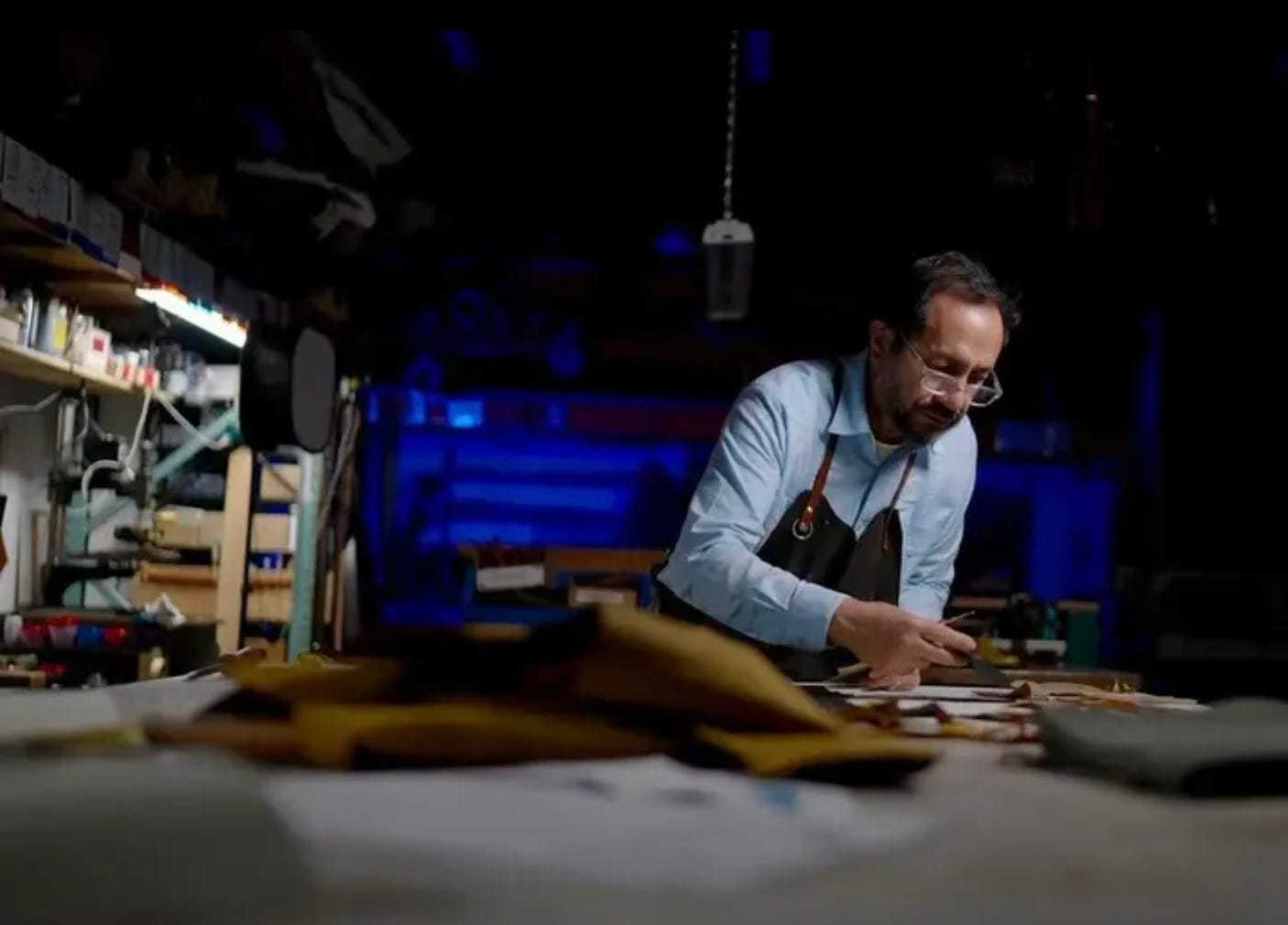
Leather has a way of announcing itself. Warm. Earthy. Permanent. The lights hung over a massive cutting table. Tools laid out like instruments. Tiny scraps in the corner that, in the right hands, could still become something beautiful.
Nothing wasted.
Don Pepe was wearing a denim apron with leather pockets.
It wasn’t decorative. It wasn’t branding. It was armor.
I asked him, “Do you sell these?”
He laughed.
“No. Too much work. Too expensive.”
I told him, “If you ever make another one, make me one.”
He hesitated.
“We don’t usually do it… but I’ll see what I can do.”
A few days later they came to Kiosko — the brothers, their wives, mom and dad. I remember exactly what I served them: Oaxacan coffee.
It felt intentional. A quiet nod.
Portland didn’t yet know how to receive businesses like ours. And to be honest, even Orox was still figuring out how loudly to exist. They didn’t want people walking in expecting charro belts and cowboy boots. That wasn’t them. They made refined handbags. Subtle goods. Durable pieces.
They were careful.
Almost neutral.
That’s what makes this story matter to me.
Because I’ve watched them choose not to stay neutral.
The Apron Becomes a Standard
Between 2018 and 2020, that apron idea grew.
Slowly. Responsibly. The way they grow everything.
By the time we opened República in 2020, the first thing I did was make sure my partner Lauro had an Orox apron. Olivia had one.
We weren’t making a lot of money back then. Not really.
So the apron became something else.
It became a trophy.
You worked hard? You earned one.
You stayed late? You earned one.
You carried the team? You earned one.
One by one, people got them. And if we couldn’t gift them, they went and bought their own.
It wasn’t about fashion.
It was about belonging.
Today, you walk into almost any serious kitchen in Oregon — especially one trying to say something beyond just “restaurant” — and someone’s wearing an Orox apron.
Baristas. Bartenders. Chefs.
Even the ones who don’t particularly care for me. Even the ones who’ve tried to replicate pieces of what we built.
The apron doesn’t take sides.
It outlived the noise.
It became a staple of Oregon Latino hospitality.
And I think back to that coffee shop, to that first custom piece, and I realize how lucky I was.
I didn’t just get an apron.
I got a front-row seat to a family growing into themselves.
The First Story I Ever Told
The first professional short I ever wrote — the first time I thought, maybe I can do this, maybe I can tell stories — was about Don Pepe.
About an eight-year-old boy in Oaxaca who asked his father for a pair of basketball shoes.
Instead of buying them, his father pulled out a last, leather scraps, and a pencil.
“Ven. Te voy a enseñar cómo se traza.”
That moment — that drawing — changed everything.
I shot it as a short film. Tiny. Imperfect. But it was ours; myself and my partner at the time, Brau Diaz.
To this day, it’s one of the most special things I’ve ever created.
There was Rose City ’Til I Die in 2022 — if you love Portland, you should be watching it. There’s an episode where I walk into the workshop and talk to Levi and the family. It’s all there.
And last year, Maestros. Diego Valeri sitting across from Don Pepe, talking about baseball on the radio in Oaxaca, about Japan, about origami, about mastery.
Two maestros meeting.
It felt right.
Watching Them Take Hits
Growth isn’t romantic.
I watched them open downtown and struggle.
I watched them get broken into. More than once. Same location.
That kind of thing takes something out of you.
I remember one night seeing someone running with a large Orox backpack. I chased them.
I don’t even know why.
It felt personal. Like someone had broken into my house. Like they’d taken something from my family.
They ran faster than I could.
They got away.
But that’s how deeply intertwined our stories had become.
This wasn’t just a brand I liked.
This was bloodline.
The Airport
Then came the airport.
Of all places.
I have my opinions about the airport — everyone does. But I won’t deny what it feels like to walk through PDX at 5 a.m. and see that Orox storefront. Or land at midnight, exhausted, and see the gate down but the name lit.
Orox.
Oregon + Oaxaca.
Still there.
Still standing.
After break-ins. After political turmoil. After pivots from leather to sushi to leather again. After starting with keychains and a borrowed press.
Still there.
That gives me joy.
Portland is lucky to have a business like that.
A business that grew responsibly.
A business that didn’t abandon craft for scale.
A business that made systems without killing magic.
This City, This Moment
Now we’re heading into 2026.
I look around at my staff wearing their aprons. I look at the chefs. I look at how far we’ve all come — all of us who didn’t have a template for what Mexican-American business could look like here.
Back then, we were careful.
Today, we’re clear.
Orox didn’t become loud.
They became rooted.
And that’s louder.
If you haven’t been, go.
Go to Old Town. Walk in. Even if you don’t buy anything.
Just stand there for a minute.
Smell the leather.
Look at the cutting table.
Look at the scraps.
Look at the piano — because that’s what it is. Don Pepe once called it that. His piano. The table where he composes in thread and hide.
And understand that cities don’t survive on headlines.
They survive on families like that.
On fathers who draw instead of dismiss.
On sons who count stitches.
On mothers who say, “Let’s try.”
On aprons that become armor.
This city is lucky.
And I am proud — not because I helped make an apron popular — but because I’ve had the honor of witnessing a family build something that will outlast trends, politics, and whatever Portland decides to call itself next.
That’s a portrait.
And it smells like leather.


